Back to School Icon Collection: A Practical Guide for Educational Designers
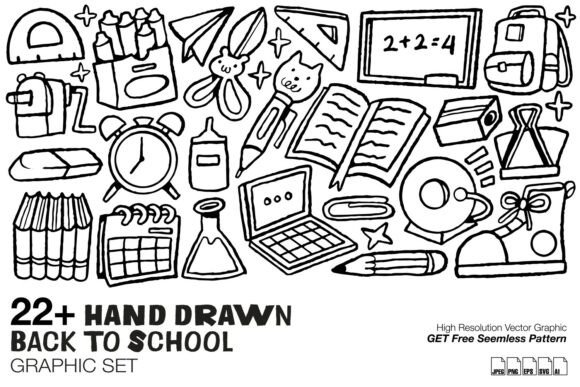
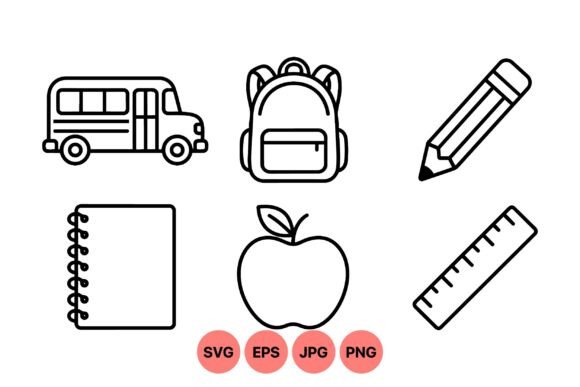
In the realm of digital and print design, visual clarity is paramount. When creating materials for educational institutions, teachers, or learning management systems, designers often struggle to find imagery that strikes the right balance between nostalgia and modern professionalism. This is where the Back to School Icon Collection becomes a valuable asset. It offers a curated set of simple line art icons depicting essential school items, including a bus, backpack, pencil, notebook, apple, and ruler. Unlike cluttered clipart or overly stylized illustrations, this collection adheres to a minimalist style suitable for education-themed designs that demand clear and clean aesthetics.
Understanding the Core Value of Minimalist Line Art
The distinction of the Back to School Icon Collection lies in its adherence to minimalism. In an era where user interfaces are increasingly complex, simplicity is not just an aesthetic choice; it is a functional necessity. The icons utilize thin, consistent strokes to represent familiar objects without unnecessary decorative elements. This approach ensures that the symbols communicate their meaning instantly, regardless of the context in which they appear.
For professionals aged 20–50 who evaluate resources based on utility and versatility, the value of such a collection is found in its scalability. The artwork is provided as high-contrast vector files (SVG and EPS), guaranteeing sharp results at any size. Whether you are designing a favicon for a school website, a large banner for a classroom entrance, or a small mobile app interface, the lines remain crisp. This eliminates the pixelation issues common with raster-based alternatives, making the Back to School Icon Collection a robust solution for responsive design projects.
Format Versatility and Technical Advantages
One of the primary considerations when selecting graphic assets is file format compatibility. Many stock icon sets restrict users to a single format, forcing designers to convert files manually or settle for lower quality. The Back to School Icon Collection addresses this limitation by providing a comprehensive ZIP folder containing SVG, PNG, JPG, and EPS files. This variety supports different workflows and technical requirements:
- SVG and EPS: These vector formats are ideal for print media, logos, and web development. They allow for infinite scaling without loss of quality and can be easily edited within design software like Adobe Illustrator or Inkscape.
- PNG: Perfect for web use where transparency is required but vector manipulation is not needed. The high-contrast nature of these icons ensures they stand out against various background colors.
- JPG: Useful for quick previews or contexts where file size reduction is prioritized over transparency, though less flexible than the other formats.
This multi-format approach saves significant time during the production phase. Instead of sourcing separate assets for print and digital platforms, designers can rely on a single purchase to cover all bases. For those evaluating tools based on efficiency, the inclusion of both editable vectors and ready-to-use rasters is a decisive factor.
Evaluating Fit: When to Choose This Collection
Determining whether the Back to School Icon Collection fits your specific project requires an honest assessment of your design goals. The minimalist style makes it particularly well-suited for modern educational branding, online course platforms, and administrative dashboards. If your goal is to create a professional, uncluttered look that emphasizes content over decoration, this collection aligns perfectly with those objectives.
The specific subjects included—the bus, backpack, pencil, notebook, apple, and ruler—are universally recognized symbols of education. Their simplicity allows them to function effectively as navigation aids, bullet points, or section headers. For instance, using a simple pencil icon to denote "homework" or a bus icon for "transportation schedules" provides immediate visual cues without distracting from the text. This clarity is essential for accessibility, ensuring that information is easily digestible for users with varying levels of literacy or cognitive processing speeds.
Ideal Use Cases
- Curriculum Development: Creating lesson plans or syllabi that require clear visual organization.
- School Branding: Developing logos or marketing materials that need to convey a sense of tradition mixed with modernity.
- Mobile Applications: Designing intuitive icons for student or parent portals where screen real estate is limited.
- Print Materials: Producing flyers, newsletters, and posters that require high-resolution graphics for professional printing.
Comparing Approaches: Minimalism vs. Illustration
When researching options, designers often weigh minimalist icons against more elaborate illustration styles. While colorful, detailed cartoons can evoke a playful, childish atmosphere, they often clash with corporate or academic seriousness. The Back to School Icon Collection occupies a middle ground. It retains the thematic essence of school supplies but strips away the whimsy that might undermine a formal presentation.
Compared to hand-drawn sketches, the vector-based nature of this collection offers consistency. Hand-drawn styles can vary in stroke weight and texture, leading to a disjointed look if multiple artists contribute to a project. In contrast, the uniform line weight of the Back to School Icon Collection ensures a cohesive visual language across all documents. However, if a project specifically aims to capture a handmade, organic feel—such as a craft workshop flyer—a custom illustration set might be a better fit than these geometrically precise line art icons.
Tradeoffs and Limitations to Consider
No single resource is perfect for every scenario. While the Back to School Icon Collection excels in versatility and clarity, there are tradeoffs to consider. The minimalist style may lack the emotional warmth found in character-driven illustrations. If your target audience is young children (under age 7) who respond better to vibrant colors and friendly faces, these black-and-white line icons might feel too sterile or abstract.
Additionally, the monochromatic nature of standard line art means that color integration relies entirely on the designer's ability to apply fills or strokes. While this offers flexibility, it also adds a step to the workflow compared to pre-colored clipart. Designers must ensure that the chosen accent colors complement the line work to maintain the intended high-contrast effect. Furthermore, while the set covers key items, it does not include niche educational tools like microscopes or musical instruments, limiting its scope to general school themes.
Decision Factors for Professionals
For professionals evaluating this resource, the decision should hinge on three main factors: brand alignment, technical requirements, and budget efficiency. The Back to School Icon Collection is a cost-effective solution because it consolidates multiple file formats into one package. This reduces the need to purchase separate assets for different media channels.
When comparing this to subscription-based icon libraries, the advantage here is ownership. Once downloaded, the SVG, PNG, JPG, and EPS files belong to the user indefinitely, allowing for unlimited usage without recurring fees. This is a significant consideration for freelance designers or small organizations operating on tight budgets. However, if a project requires a massive volume of diverse icons beyond the school theme, a broader library subscription might offer better long-term value.
Making the Final Choice
Ultimately, the Back to School Icon Collection serves as a reliable foundation for education-themed designs. Its strength lies in its ability to communicate clearly through simplicity. By choosing this collection, designers gain access to high-quality, scalable graphics that respect the viewer's attention span and enhance readability. It is the right choice when the priority is professional polish, technical flexibility, and universal recognition.
However, if the project demands a highly specific artistic voice, extensive thematic variety, or a child-centric playful aesthetic, exploring alternative illustration styles may be necessary. By understanding these nuances, designers can make informed decisions that align their visual assets with their strategic goals. Whether for a university brochure or a local community center newsletter, the clarity provided by this collection ensures that the message remains the focal point, supported by visuals that are as effective as they are elegant.